
If you have avoided the dentist for years, you are not the first person to walk into our office feeling that way. Many people are not only worried that treatment will be uncomfortable. They are embarrassed. They expect a lecture. They are afraid someone will make them feel worse about how long it has been.
That is not how Dr. Dawson works.
Dr. Dawson most enjoys working with patients who have the most apprehension. She likes helping the scariest procedure become a “no big deal” procedure whenever that is possible. As she puts it, “I’m a very gentle doctor and people tend to like me because I have small hands.” Even when treatment is difficult, her goal is to end the appointment on a positive note.
Sedation may be part of the plan for some patients. It is not automatic, and it is not the same for everyone.
What sedation can and cannot do
Sedation can help some patients feel calmer during dental care. People ask about it for different reasons, including fear, a strong gag reflex, difficulty tolerating longer appointments, or a bad past dental experience.
Sedation is not a substitute for numbing. If your dental treatment needs local anesthetic, Dr. Dawson will still use it when appropriate.
Nitrous oxide and Level 1 minimal sedation are not general anesthesia. The goal is to help you relax while you stay awake and able to respond.
What Dr. Dawson provides herself
At Dawson Family Dentistry, the sedation Dr. Dawson provides in-house is limited to:
- Nitrous oxide
- Level 1 minimal sedation, when appropriate, under her Level 1 permit
Dr. Dawson does not provide IV sedation. She does not provide deep sedation.
For sedation beyond Level 1 minimal, including oral conscious sedation and IV sedation, an anesthesiologist may come to our office when arranged in advance. The anesthesiologist is responsible for the anesthesia care, monitoring, and recovery instructions. Dr. Dawson is responsible for the dental treatment.
We want you to know that difference before anything is scheduled.
Sedation is planned before the treatment day
Sedation is not decided when you arrive for treatment. It is not available on demand, and not every patient is a candidate.
The first step is an exam and a review of your health history. After the exam, you will receive a written treatment plan. If major treatment is needed, we send a predetermination to your insurance company first.
Once there is a treatment plan and Dr. Dawson has reviewed your health history, she may be able to prescribe medication to help you relax. If a higher level of sedation is being considered, that planning involves the anesthesiologist as well.
Please tell us about your concerns when you call. The more we know ahead of time, the better we can plan the visit.
Options we can talk about
Nitrous oxide
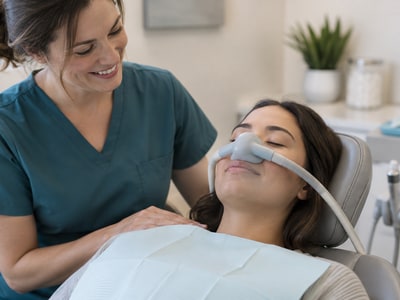
Commonly called laughing gas, nitrous oxide is a mild sedative used to reduce anxiety and help you relax during treatment. It is inhaled through a small mask over the nose, given in combination with oxygen, and used for the length of the procedure. Once it is turned off the effects wear off very quickly and you return to full awareness. It can also help reduce gagging for patients with a strong gag reflex.
Level 1 minimal sedation
Dr. Dawson holds a Level 1 permit. For some patients, after a treatment plan is in place and the health history has been reviewed, she may be able to prescribe medication to help the patient relax.
This is minimal sedation. It is not IV sedation. It is not deep sedation. It is not appropriate for every patient.
With this kind of prescribed medication, you must have an escort on the day of the procedure to drive you to and from the office.
Sedation provided by an anesthesiologist
For deeper sedation, an anesthesiologist may come to our office when arranged in advance. The anesthesiologist provides oral conscious sedation or IV sedation. Dr. Dawson does not provide those forms of sedation herself.
For these appointments you will need an escort present for the appointment and on hand to drive you home when the visit is completed. The anesthesiologist will also give you their own instructions to follow beforehand and afterwards.
Bringing someone with you
If your appointment involves sedation, we will tell you beforehand whether you need someone to accompany you to the office and home following treatment. Please do not assume you can drive yourself unless our office has told you so directly.
If you are embarrassed about your teeth
You do not have to explain everything before you come in. You do not have to apologize for the condition of your teeth. You do not have to defend how long it has been.
We need to know what is happening now so we can help you make a plan. That starts with an exam, a conversation, and a written treatment plan.
Some patients need a small first step. Some need major treatment planned over time. Some need sedation, and some do better with a slower pace, clear explanations, and breaks during the appointment. Dr. Dawson will talk with you about what makes sense for your situation.
Children and patients with disabilities
Dawson Family Dentistry sees children from age 2. That does not mean every sedation option is appropriate for a child. If you are calling about sedation or comfort for a child, please call us so the situation can be discussed in advance.
If you or a family member has a disability, please tell us when you call. We can talk through the appointment, your health history, what helps, and what needs to be planned ahead of time. Sedation is considered individually and only when appropriate.
Call to talk with us
Sedation questions are best handled by phone. There is usually more to discuss than can be handled well in a form.
Call Dawson Family Dentistry in Lewisville at (972) 317-1581.
If fear, embarrassment, or a difficult past dental experience has kept you away, call us. You will not be the first person to say it has been a long time.
Frequently Asked Questions
What is sedation dentistry?
+Sedation dentistry offers patients with general anxiety or fears about a dental procedure the opportunity to have a more comfortable and stress-free experience. By utilizing safe and controlled sedation techniques, the patient is eased into a state of complete relaxation before the procedure. This approach eliminates discomfort, pain, and preoperative anxiety, and typically makes patients feel more at ease post-operatively, as they have little or no memory of the actual moment-to-moment procedure.
What is the difference between local anesthesia and dental sedation?
+Local anesthesia involves an injection directly into or close to the area where a procedure is being performed. While it eliminates any sensation of pain in the targeted area, it does not affect your state of mind or level of anxiety. When a patient receives sedation, additional medications to ease anxiety and promote relaxation are employed in advance of local anesthesia. In this way, both the stress and discomfort associated with a procedure are eliminated. Sedation can be administered in a variety of forms based upon patient needs and the recommendations of the dentist or dental anesthesiologist.
What are the different types of dental sedation?
+Choosing the most appropriate method of sedation for a procedure depends on a variety of factors such as a patient's medical history and their level of anxiety. Dental sedation can come in the form of nitrous oxide sedation, oral conscious sedation, and IV sedation. Certain patients receiving comprehensive treatment or undergoing a complex surgical procedure may require general anesthesia in a hospital setting.
Nitrous oxide, or "laughing gas," is a mild sedative, which is inhaled through a small mask over the nose. A standard in dental sedation for decades, the effects of nitrous oxide are almost immediate and wear off quickly once your procedure is completed.
Oral sedation involves the prescription of an oral medication prior to your appointment. Taken at the recommended time before your visit, oral sedation allows you to feel fully relaxed by the time you're ready for your procedure. With oral sedation, it's necessary to plan on having an escort to and from your dentist's office.
IV Sedation is administered intravenously, or directly into a vein. It is typically indicated when a deeper state of sedation is required. Your dentist will provide you with specific instructions before your visit, and require that you have an escort for the trip home from your appointment.